
This content may include affiliate links, which means if you click on them, I may get a commission. The cool thing is, there’s no extra cost to you!
Ditch Your Old To Do List for the Most Productive 15 Minutes of Your Life! This is The Sprint List Method
You tried all the to do lists and planners and calendars and still failing, forgetting, and feeling overwhelmed. This is for you.
I have a certificate on my wall. Years ago, working grants and contracts across two counties, my team awarded me the title “Weapon of Mass Production”. I've always been someone who gets things done, a Generator in Human Design terms, wired to produce.
And even with all of that, this system made me more productive than I've ever been before.
I started back in 2011. It's now gone viral on TikTok multiple times in the last year, and a bullet journal creator is featuring it on Instagram this week. So I'm dusting off the resources and getting them ready for everyone who's about to find this for the first time.
This is the Sprint List.
Why The Sprint List is Important for You
Right now, your to do list probably lives in your head.
That creates mental clutter and stress, leading to racing thoughts at night when you can't turn your brain off, and to the moment in the shower when everything you haven't done floods in at once. Try a do-nothing day, and you'll feel it immediately, because there's too much happening in your head to actually do nothing.
Notes end up scattered everywhere: scraps of paper, Google Docs, the fridge, and the margins of your journal.
The result is that you're anxious all the time, feel behind, and never have a clear picture of how much you've actually accomplished. That fuels self-judgment, and it erodes trust, both the trust other people place in you and the trust you place in yourself.
Trust in yourself is foundational. You have to trust yourself before you can trust the process, the market, the universe, whatever you want to call it. That's the law of correspondence. When self-trust erodes, it breaks the rapport between your conscious and unconscious minds, and you end up operating on half your brain.
This process fixes that conflict.
The Sprint List moves the chatter out of your head and onto paper. It keeps your focus locked because you can't add to the list mid-week; everything new waits its turn.
The Sprint List allows you to accomplish a huge amount in a short window because your attention stays on three things instead of thirty.
Big ideas get captured and broken down instead of looping endlessly in your mind.
Anxiety drops because you're no longer worrying about forgetting something or dropping the ball.
Crossing things off gives you a visual record of what's finished, and destroying the completed list at the end feels genuinely good.
Every time you run this process, you deepen the trust between your conscious and unconscious mind.
What is The Sprint List Method?
Ditch your old to do list.
Every week, you'll work with two lists.
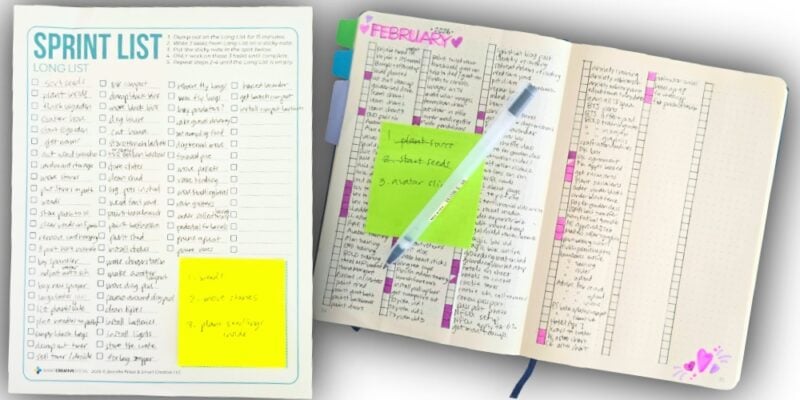
The Long List is your reference point.
Set a timer for 10 to 15 minutes and brain dump everything you can think of onto a page, notebook paper, printer paper, the back of a bill – it doesn't matter. Write down everything you'd ever want to do, even if it's not possible this week, even if it's a cruise you're not taking for two years. The goal is to clear the mental chatter, the unrealized desires out of your head. Once they are on paper, your brain stops carrying all of that information around.
The Sprint List is your game plan.
Pull three tasks from your Long List and write them on a sticky note; a three-by-three sticky note works best. Those three tasks get done before anything else is added or removed from the list. No swapping tasks because something else looks more interesting. No cherry-picking the fun stuff.
Choose three tasks from the long list, write them on the Sprint List (your 3×3 sticky note), and then complete them.
What doesn't go on the Long List: appointments and anything with a deadline. Add these tasks to your calendar.
Essential Sprint List Supply List
To create your Sprint List, let's keep things simple. You'll need:
- sticky notes
- a pen (a Muji pen if you want to be fancy about it, a regular one works fine)
- a highlighter
- a kitchen timer or your phone
- a piece of notebook paper
A fancy planner isn't required, and honestly, most of those exist to sell you something. I know because I used to be the marketing director for a planner company.
How to Use The Sprint List Method
Step one: Set a timer for 15 minutes. A kitchen timer works well because you have to physically get up and go turn it off, which breaks the state of list-making. Your phone works too, just put it across the room.
Step two: Brain dump everything onto the page. Sit through the full 15 minutes even if you feel finished early, the good stuff tends to surface in waves, like peeling layers off an onion.
Step three: Pick three tasks from the Long List and write them on your sticky note. This is your Sprint List.
Step four: Work only those three tasks until they're complete. Nothing else gets touched.
Step five: Cross the finished tasks off the Long List, toss the sticky note (burn it ceremoniously if you want), and pick three new tasks from the Long List.
Step six: Repeat.
5 Foolproof Methods for Choosing Three Tasks for Your Sprint List
I have five tried-and-true strategies for choosing what to put on the Sprint List from the Long List.
The Ordinal Method: Break a project into ordered steps and add the next 3 steps to your Sprint List.
Random Method: Pick something at random from the Long List. Just start.
Needle Mover: Choose the three tasks that move your biggest goal forward the most
Focus Mix: One task each from personal, home, and work foci.
Time Mix: Choose one quick task (under 15 minutes), one medium task (1 to 2 hours), and one long task (3 to 4 hours) for your Sprint List.
Is Your Calendar Packed?
Carve out dedicated sprint time or use open pockets of time as they arise to get things done from your Sprint List. The goal is to get things done, not have another to do list that never ends or gets completed.
Cut what isn't necessary if the calendar leaves no room at all for you to get Sprint List tasks done.
Sometimes a task on your list represents a decision more than an action. Facing it reveals the decision was to skip it. Cross it off the Sprint List, mark it done or scratched on the Long List, and move forward.
What if I Want to Move Faster or Slower?
I advise everyone to start working your list weekly, not monthly. A weekly cadence gives you 52 reps per year, compared to 12 with a monthly rhythm. Get good at the weekly pace before considering a monthly pace.
I ran the Sprint List weekly for eight years before shifting to monthly in 2023, and that shift only worked because the weekly habit was already locked in.
Ready for the Advanced Version?
After a full year of consistent weekly practice, consider adding new layers of sophistication:
- Monthly cadence instead of weekly
- A dot grid layout with columns and checkboxes
- Categorized, color-coded columns (mine run general, volunteer, garden, home, right now)
- Partial-completion marks for tasks in progress
- New tasks added throughout the month as they surface
This only works if you can stay disciplined enough to leave old lists alone and trust the current one completely. Framework™ walks through the full advanced system, the tracking tools, and the categorization method that makes the monthly version work. Get the full Sprint List training here, including printable lists.
Grab the Free Sprint List Download
A printable one-sheet makes starting this today simple. Grab it, along with sticky notes, a pen, a highlighter, and a timer, and run your first Long List this week. Get the Printable Sprint List here.
Thousands of people have told me that this list process was a gamechanger for them. I get 100s of comments every week on my videos showing the process!
Share how the Sprint List worked for you in the comments below. And if you have any questions, I am happy to help.
About the Author

Jennifer Priest is a 20+ year designer in the arts & crafts industry and home DIYer with a passion for creativity. An Army veteran raised on a ranch, from her experience, she shares smart DIY projects that save money and fun craft ideas that anyone can make. Besides blogging, Jennifer is a Master Practitioner and Trainer of NLP, Hypnosis, and MER, and coaches other online entrepreneurs on money mindset, business, and living an intentional life. When not blogging, Jennifer is having adventures in the wilderness, on road trips, playing with her cats, and making paleo food.